

Have you ever had a question you were afraid to ask?
I’m not talking about school days when you finally raised your hand and started with, “This might be a dumb question…” only to hear the teacher say, “There’s no such thing as a dumb question.”
I mean a question that, if answered honestly, might change your world.
Maybe it was a question about God.
Maybe it was a question about the church.
Maybe it was a Bible story you had heard your entire life but suddenly saw in a troubling new light.
You had a question and were afraid to ask it, not because you thought it was stupid, but because you realized where it might lead.
Growing up in the church, I knew that fear well.
I was taught that having faith meant having answers. Good Christians had answers. Successful pastors had even more answers. And, of course, if there was no plausible answer at all, we were told to take it by faith.
It was okay to ask questions as long as they pointed you back to what we already knew.
I learned the hard way that there were acceptable answers and there were right answers. Too often, they were not the same thing.
While in seminary, I took a class on the book of Isaiah from a very conservative professor. We explored the authorship of Isaiah. Conservative scholars argued for one author. Less conservative scholars argued for two. Liberal scholars made the case for three.
At the end of the semester, we were asked to write an essay answering a simple question: How many authors wrote Isaiah?
I had studied hard. I knew what I believed. I made the case for three authors.
I knew it was risky because the professor was very conservative. But I assumed he would grade me on my knowledge and the strength of my argument.
When my paper was returned, I was stunned. A large red C glared back at me.
I had taken several classes from this professor. On every test and assignment, I had earned an A or a B.
There were no corrections on my paper. No comments. No explanation.
Then it hit me.
I had not given the acceptable answer.
Maybe you learned the same lesson in a different way.
When you asked a question, someone changed the subject.
A pastor warned you not to “go down that road.”
A Sunday School teacher told you to take it by faith.
Someone made it clear there could be a price for asking the wrong question.
You didn’t get a C on a test, but you learned the lesson. There were acceptable answers and there were right answers. Eventually, you started editing your own questions before opening your mouth.
So what questions are you afraid to ask out loud?
Are you afraid to ask how the God of the Old Testament can sometimes appear so bloodthirsty?
Are you afraid to ask what happened to someone you loved after they died?
Are you afraid to ask whether the Bible is really infallible?
Are you afraid to ask whether the church might be wrong about something you were told could never be questioned?
Giving yourself permission to ask can feel dangerous. It can feel like stepping onto thin ice and hearing it crack beneath your feet.
But I have also discovered something else. Sometimes the question you are most afraid to ask is the one that finally sets you free.
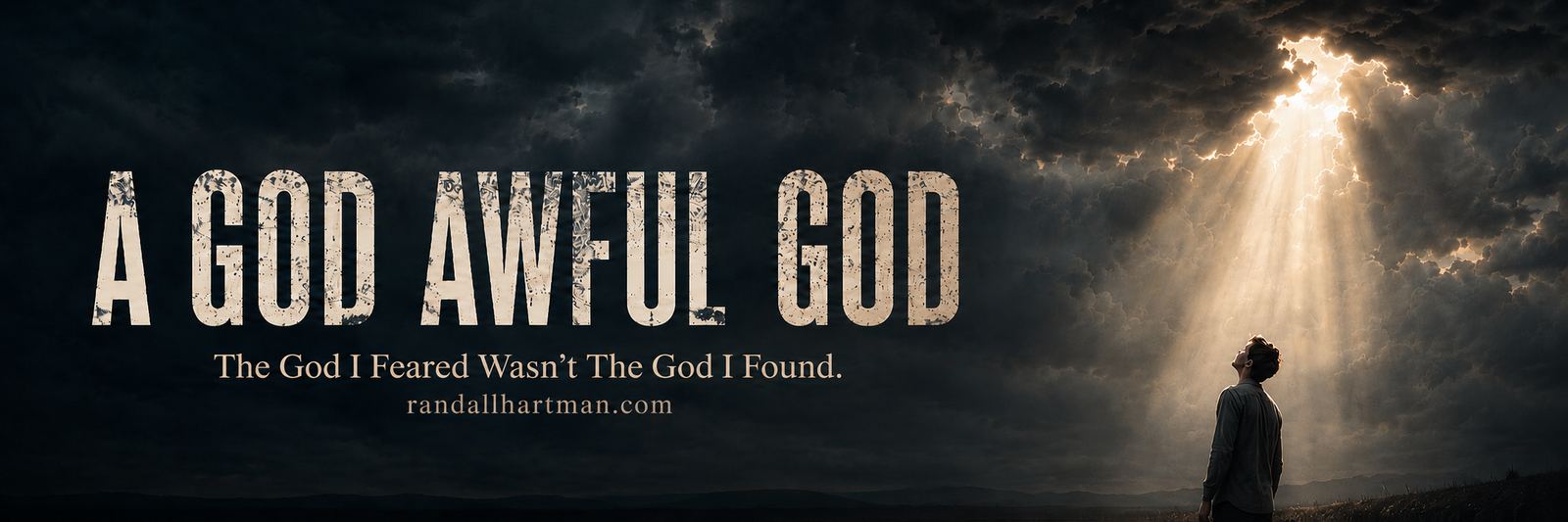
A God Awful God: The God I Feared Wasn’t The God I Found is the story of the questions I was afraid to ask, and what happened when I finally gave myself permission to ask them.
Near the end of the book, I imagine talking to the frightened little boy I once was. I tell him what I wish someone had told me much earlier: questions are not dangerous.
If that sounds like your story too, I’d love to have you join my book email list here:
Leave a Reply