

I was seven years old when the church gave God a name I feared: Father.
Looking back, I realize that word was supposed to make me feel safe. It didn’t.
When my Sunday School teacher prayed, “Dear Heavenly Father,” it didn’t give me warm fuzzies. I pictured my dad standing over me with a leather belt ready to swing across my bare butt. “Father” meant anger. Terror. Danger.
Decades later, I began to understand what had taken place in me. God didn’t create my fear. He inherited it.
Long before I knew what the word “theology” meant, I constructed an image of God. To build that image, I used the raw materials life had given me.
At that early age, I knew what anger looked like and what unpredictable power felt like. I learned the wisdom of staying quiet, reading the room, and trying not to make my father angry.
Then the church told me God was my Father. So I filled in the blanks.
I suspect we all do this.
Centuries ago, the Greek philosopher Xenophanes wrote that people had a tendency to imagine that the gods looked like themselves. His observation sparked writers to say that rather than God creating us in his image, we create God in ours.
But I think we do more than shape God in our image. We give Him our history.
If the people who held power in our lives were gentle, we may find it easy to imagine a gentle God. If we felt loved and valued in our childhood, trusting divine love may come naturally. But if authority was scary, unpredictable, controlling, or conditional, those experiences often follow us right into church.
We might hear a Sunday School teacher say, “God is watching us.” Because of our experiences, we imagine a God watching from afar, not caring for us, but waiting for us to mess up.
If we hear the preacher say that God judges us, we imagine someone waiting for us to fail so the leather belt can be applied.
When someone begins their prayer with “Heavenly Father,” we unknowingly attach an earthly father’s face to the word. And we shrink back.
As we live with this picture of God created by fear, something strange happens.
We start defending our picture of God as though God Himself painted it.
That thought eventually forced me to ask one of the most important questions of my life: What if some of the things I believed about God had never belonged to God at all? Was God really like the power person in my life who terrified and controlled me?
That question sent me back to Jesus.
The God I saw in Jesus began reshaping the God I had feared.
Jesus moved toward wounded people instead of away from them. He touched people others avoided. He welcomed children. He ate with people the religious institution pushed aside. He seemed far more interested in healing people than scaring them.
Slowly, something changed.
I began taking things back from God that I had put on Him.
The anger.
The fear.
The lightning in His eyes.
And underneath all of that, I began discovering someone I had not expected.
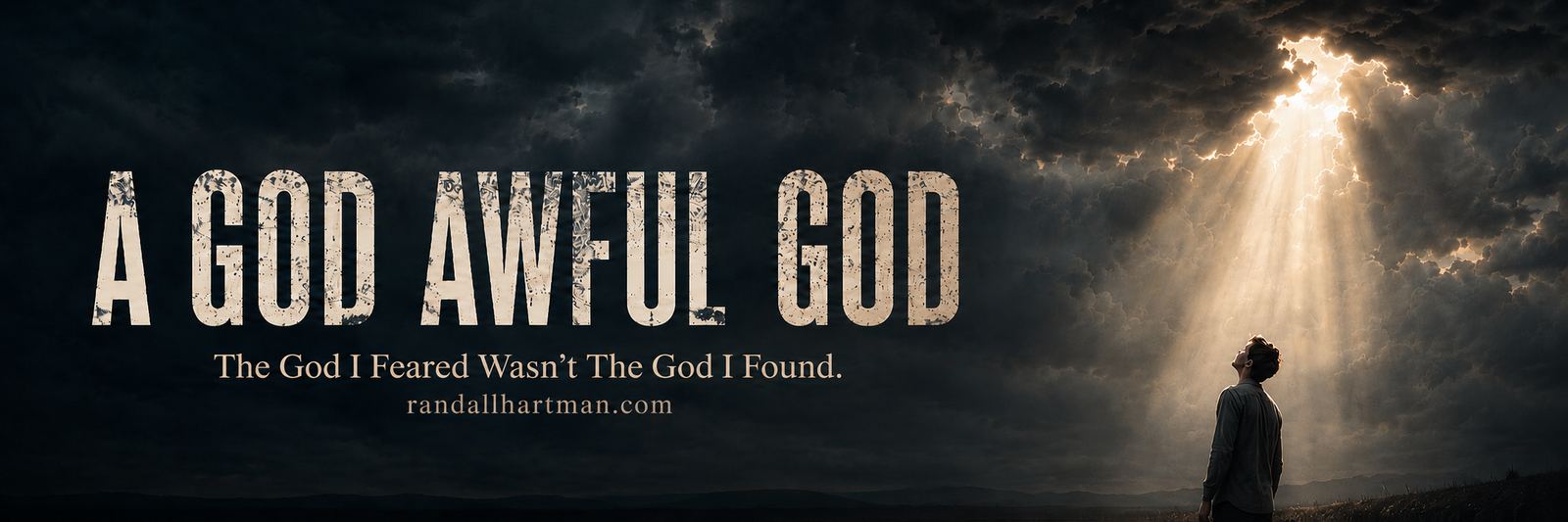
This journey is at the heart of my upcoming memoir, A God Awful God: The God I Feared Wasn’t the God I Found.
If you’ve ever wondered whether the God you fear is really God or a picture assembled from things that happened to you, I wrote this book with people like us in mind.
You can join my book email list below for occasional excerpts, behind-the-book stories, and publication updates.
Leave a Reply